
Table of contents
- Table of Contents
- Introduction – A Patchwork of Prostitution Laws in Europe
- Key Takeaways in Brief (TL;DR)
- Definitions & Methodology
- What We Mean by “Sex Work” in This Article
- The Four Legal Models Used in This Overview
- Scope, Timeframe and Sources
- Overview of the Four Legal Models
- Legalisation & Regulation
- Abolitionism
- Nordic Model (Sex Buyer Law)
- Prohibition / Full Criminalisation
- Map of Europe: Which Country Uses Which Model?
- Countries with Legalisation & Regulation
- Abolitionist Countries
- Nordic Model Countries
- Prohibition Countries
- Model 1 – Legalisation & Regulation in Detail
- Core Legal Principles
- Typical Rules and Instruments
- Arguments For and Against Legalisation
- Evidence on Outcomes
- Country Snapshot: Germany
- Other Examples
- Model 2 – Abolitionism in Detail
- Core Legal Principles
- How the Law Works in Practice
- Arguments For and Against Abolitionism
- Evidence on Outcomes
- Country Examples
- Model 3 – Nordic Model (Sex Buyer Law) in Detail
- Origins and Core Idea
- Legal Design
- Implementation and Enforcement
- Arguments For and Against the Nordic Model
- Evidence from Research
- Country Examples
- Model 4 – Prohibition & Full Criminalisation in Detail
- Legal Framework
- Enforcement in Practice
- Critiques and Defences
- Country Examples
- Comparing the Models: What the Research Says
- Safety and Violence
- Trafficking and Exploitation
- Market Visibility and Data Quality
- Workers’ Rights, Health and Stigma
- Germany in the European Context
- The German Legalisation & Regulation Model
- Comparisons with Neighbouring Models
- How Other Models Shape the German Debate
- Practical Implications for Workers and Clients
- Travelling Within Europe
- Online and Cross-Border Services
- Law on Paper vs. Everyday Reality
- Summary & Quick Reference Cheat Sheet
- Bullet Summary
- Quick Reference Table
- Methodology, Sources & Further Reading
- How Data and Studies Were Selected
- Limitations and Caveats
- Suggested Citation
- Further Reading
From the outside, Europe can look tidy and unified. But when it comes to sex work, the continent is a legal patchwork: one border crossing can turn a perfectly legal escort booking into an offence for the client, the worker, or both. Some countries regulate brothels like any other business, others criminalise the buyer, and a few still ban prostitution altogether. This article walks you through the four main legal models, shows which countries use which approach, and explains what that means in practice for sex workers, clients, and anyone trying to understand the debate.
Table of Contents
- Introduction – A Patchwork of Prostitution Laws in Europe
- Key Takeaways in Brief (TL;DR)
- Definitions & Methodology
- Overview of the Four Legal Models
- Map of Europe: Which Country Uses Which Model?
- Model 1 – Legalisation & Regulation in Detail
- Model 2 – Abolitionism in Detail
- Model 3 – Nordic Model (Sex Buyer Law) in Detail
- Model 4 – Prohibition & Full Criminalisation in Detail
- Comparing the Models: What the Research Says
- Germany in the European Context
- Practical Implications for Workers and Clients
- Summary & Quick Reference Cheat Sheet
- Methodology, Sources & Further Reading
Introduction – A Patchwork of Prostitution Laws in Europe
Europe is often talked about as if it had “one” model of dealing with prostitution. In reality, EU member states and neighbouring countries follow four broad approaches that combine very different legal ideas and social goals. Some have chosen legalisation and regulation, treating sex work as a business that should be monitored and taxed. Others remain close to abolitionism, where selling sex is tolerated but brothels and third-party organisation are heavily criminalised. A growing number have adopted the Nordic model, criminalising the purchase of sex while framing the seller as a victim. A smaller group relies on prohibition, where selling and buying are both offences.
These models are not just legal abstractions. They influence where sex work happens (street, brothels, apartments, online), how safe or risky different settings are, how visible the market appears in statistics, and how politicians talk about trafficking and exploitation. For Germany, which follows a regulated legalisation model, comparisons with Sweden, France or neighbouring prohibition countries play a central role in political debates.
This article is part of the Research & Statistics section of Ivana Models Magazine. It is written for journalists, researchers, policy makers and informed clients who need a calm, fact-based map of prostitution laws in Europe—without moral panic and without romanticising the industry.

Key Takeaways in Brief (TL;DR)
- European countries cluster around four models: legalisation/regulation, abolitionism, Nordic model, prohibition.
- Germany belongs to the legalisation/regulation group, alongside countries such as the Netherlands, Austria, Greece and Switzerland, where selling and buying sex are legal but regulated.
- The Nordic model (criminalising buyers, not sellers) originated in Sweden and has since been adopted by countries including Norway, Iceland, France and Ireland.
- In abolitionist systems, selling sex is not a crime, but brothels and many third-party activities are illegal, which often pushes activity into semi-legal or informal spaces.
- Prohibition regimes criminalise both selling and buying sexual services; these are now a minority in the EU but remain influential in some Eastern and Southern European states.
- Research suggests that indoor, regulated and worker-controlled settings are generally associated with lower levels of violence than street-based or highly criminalised environments, regardless of model.
- No model has “solved” trafficking or exploitation. Data on trafficking are difficult to compare, and political actors often highlight or downplay figures to support their preferred approach.
The rest of the article explains these models in detail, shows which countries fall into which group, and summarises what comparative research actually tells us.
Definitions & Methodology
What We Mean by “Sex Work” in This Article
For clarity, this article uses the term sex work in a broad, descriptive sense: adults who provide sexual or erotic services for money, on a regular or occasional basis, regardless of gender, migration status or exact work setting. This includes street-based prostitution, brothels and clubs, escort services, erotic massage, and in some contexts online or digital services such as camming or subscription content.
The term prostitution appears when referring to legal texts, official statistics or policy debates that explicitly use that language. This mirrors much of the research literature and the wording of many European criminal codes.
The Four Legal Models Used in This Overview
European scholars and institutions group national laws into a small number of policy approaches. Building on work by the European Parliament, NGO mappings and academic analyses, this article uses four main models:
- Legalisation & regulation: selling and buying sex are legal under certain conditions. The state regulates sex work via licensing, zoning, registration or health rules, often focusing on venues and business operators.
- Abolitionism: selling sex itself is not a crime, but most forms of organising or profiting from others’ prostitution (brothels, pimping, some third-party activities) are criminalised. The long-term goal is often abolition of prostitution as a social phenomenon.
- Nordic model (sex buyer law): selling sex is decriminalised or not prosecuted, but paying for sex is criminal. Campaigns frame prostitution as a form of violence or gender inequality, and policy focuses on reducing demand.
- Prohibition / full criminalisation: both selling and buying are offences, often alongside strict bans on soliciting and brothel-keeping. Here, prostitution is treated primarily as a public-order or morality problem.
Scope, Timeframe and Sources
The focus lies on EU member states plus a few non-EU European countries (Norway, Iceland, Switzerland, United Kingdom and Turkey) that significantly shape the debate. Descriptions reflect the situation roughly up to late 2024; individual laws and enforcement practices may change after that.
Main source types include:
- European Parliament analyses of prostitution laws in EU member states.
- European NGO mappings such as TAMPEP reports.
- Comparative academic work on prostitution policy models.
- Country overviews on prostitution in Europe.
Because legal systems are complex and sometimes hybrid, the groupings below are indicative rather than mathematically exact.


Overview of the Four Legal Models
Legalisation & Regulation
Legalisation and regulation treat sex work as an activity that should be brought into the open and monitored. Selling and buying sex are legal for adults, while the state regulates venues, business operators and sometimes individual workers. Typical tools include licensing requirements for brothels and clubs, zoning rules, mandatory information sessions, and, in some countries, registration or health checks for workers. Germany, the Netherlands, Austria and Greece are often cited as examples of this model, although the details vary.
Abolitionism
Abolitionist systems emerged in the 19th and early 20th centuries as a reaction to state-regulated brothels. They consider prostitution inherently exploitative and aim to abolish it over time, but usually do not criminalise the selling of sex itself. Instead, they target third parties: brothel-keeping, pimping, “living off the earnings” of prostitution, or organising spaces for sex work. In practice, this often pushes prostitution into apartments, streets or semi-legal venues, where workers rely on informal intermediaries rather than openly licensed businesses.
Nordic Model (Sex Buyer Law)
The Nordic model, first introduced in Sweden in 1999, focuses on the demand side. Selling sex is decriminalised or tolerated, while buying sex is a criminal offence. Lawmakers present this as a way to send a moral message, reduce demand and combat trafficking. Norway, Iceland, France and Ireland are among the countries that have adopted versions of this approach.
Prohibition / Full Criminalisation
In prohibition regimes, both parties to the transaction can be prosecuted. Laws typically ban soliciting, brothel-keeping and third-party involvement as well. Prostitution is framed primarily as a threat to public order, morality or national security. While full criminalisation has become less common in the EU, it remains influential in parts of Eastern and South-Eastern Europe and in some non-EU states.

Map of Europe: Which Country Uses Which Model?
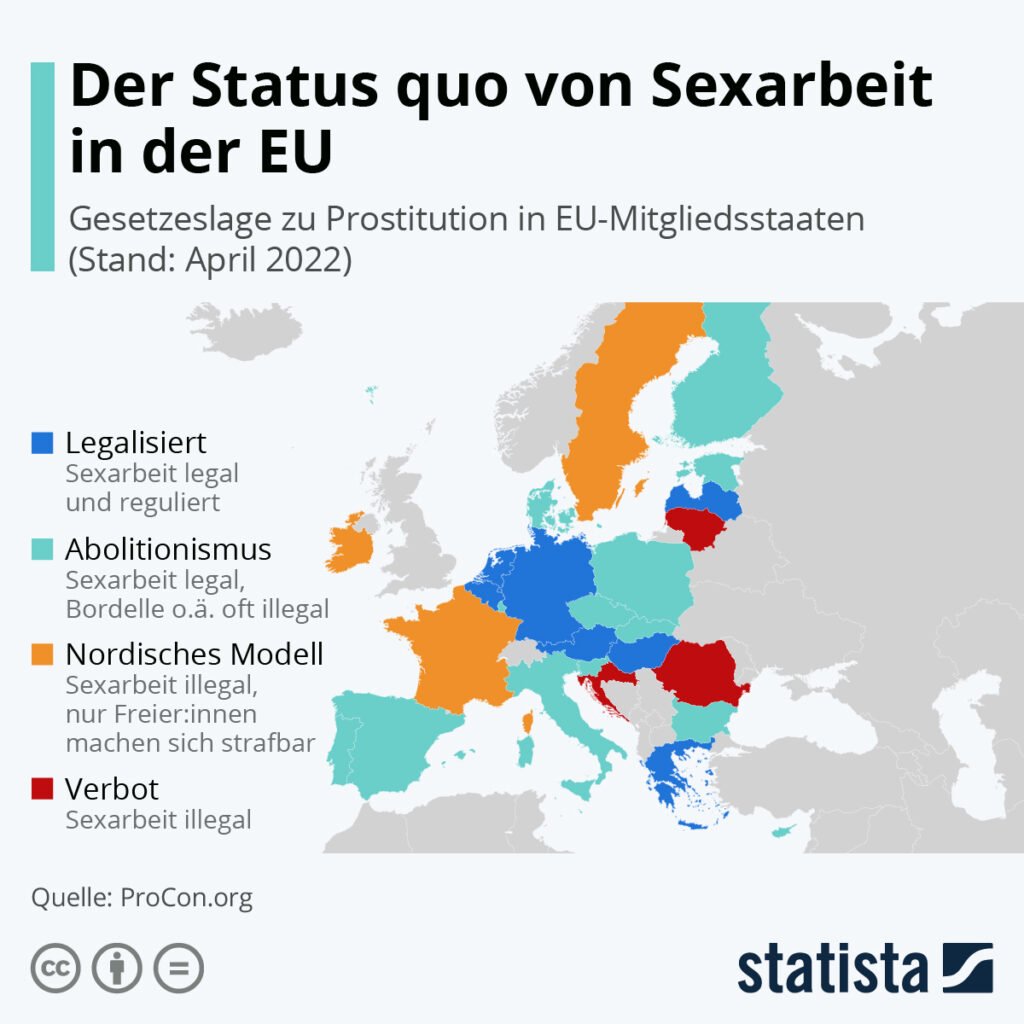
Visual maps, like the one produced by Statista and ProCon.org, are popular because they show at a glance how fragmented Europe’s approach to prostitution really is. The exact grouping depends on where one draws the lines, but most mappings distinguish four clusters similar to those used here.
Countries with Legalisation & Regulation
Countries in this group allow prostitution as such and have relatively clear legal frameworks for venues and business operators. Depending on how one classifies borderline cases, they typically include:
- Germany – regulated legalisation with licensing and registration duties.
- Netherlands – legal brothels and window prostitution, with licensing at municipal level.
- Austria – legal and regulated, with regional rules and health requirements.
- Greece – prostitution legal and regulated in licensed brothels.
- Switzerland (non-EU) – sex work legal nationwide, regulated by cantonal rules.
- In some mappings: Belgium, Hungary, Latvia and a few others are classed as legal but less uniformly regulated.
Abolitionist Countries
Abolitionist legal frameworks remain influential in parts of Western and Southern Europe. Here, selling sex is technically legal, but brothels and organised prostitution are banned. Examples, depending on the classification used, include:
- Italy – prostitution legal, brothels and exploitation offences heavily penalised.
- Spain – legal grey zone, with repeated attempts to move towards a more abolitionist or Nordic-style approach.
- Portugal – selling sex not criminal, but brothel-keeping and pimping are offences.
- Several Central and Eastern European states where prostitution itself is not an offence but organised forms are.
Nordic Model Countries
Countries that have adopted versions of the Nordic model include:
- Sweden – introduced the sex buyer law in 1999.
- Norway – criminalised clients in 2009.
- Iceland – similar law, with prostitution framed as a form of exploitation.
- France – 2016 law penalising buyers, accompanied by exit programmes.
- Ireland – adopted client criminalisation in 2017.
- Some analyses add other states that have partially adopted demand-focused provisions.
Prohibition Countries
Full criminalisation is less common today but still present. Examples include:
- Some South-Eastern and Eastern European countries where both selling and buying are offences and enforcement focuses on street work and visible venues.
- Non-EU neighbours like certain Balkan states, where prostitution remains illegal under criminal law.
Because laws are evolving, any list risks being outdated quickly. For up-to-date legal details, readers should always check national legislation in addition to this high-level overview.


Model 1 – Legalisation & Regulation in Detail
Core Legal Principles
In legalisation regimes, sex work is not treated as a criminal offence but as a sector that should be regulated. Adults may sell and buy sexual services; the focus of criminal law shifts to coercion, trafficking, involvement of minors and unlicensed operations. The guiding idea is that bringing prostitution into a legal framework makes it easier for the state to monitor, tax and—in theory—protect those involved.
Typical Rules and Instruments
Regulation can take many forms:
- Licensing for venues and operators (brothels, clubs, agencies), with requirements on personal reliability, safety plans and financial transparency.
- Zoning rules that define where prostitution may take place (red-light districts, tolerance zones, bans near schools or churches).
- Registration or information sessions for sex workers, as in Germany’s Prostitute Protection Act.
- Health-related provisions, ranging from mandatory counselling to, in some countries, medical examinations.
Enforcement typically involves inspections of venues, checks of licences, and cooperation between police, public health authorities and tax offices.
Arguments For and Against Legalisation
Supporters argue that legalisation can:
- make it easier for sex workers to report violence without fear of prosecution,
- reduce police harassment and arbitrary crackdowns,
- allow authorities to target exploiters and traffickers more precisely,
- create more transparent working environments and tax contributions.
Critics respond that legalisation can also:
- expand the market and attract international sex tourism,
- leave large parts of the sector unregistered and unprotected,
- normalise commercialisation of intimacy in ways some find socially harmful,
- create bureaucratic burdens that some workers cannot or do not want to fulfil, pushing them back into informal economies.
Evidence on Outcomes
Comparative research generally suggests that legalisation alone does not automatically guarantee safety or equality. However, when combined with worker-led organisations, accessible health services and non-stigmatising institutions, regulated environments can be associated with lower levels of physical violence and better access to support than highly criminalised settings.
Country Snapshot: Germany
Germany is often cited as a key example of regulated legalisation. Prostitution has been legal for adults for decades, and the 2002 Prostitution Act recognised sex work as a legitimate service, while the 2017 Prostitute Protection Act introduced licensing for businesses and registration duties for workers. Debates continue over how effective these measures are in improving safety and reducing exploitation. A more detailed exploration of the German case is available in our article “Sex Work in Germany: Law, Market Size & Key Statistics”.
Other Examples
The Netherlands follows a legalisation model with strong municipal control over brothels and window prostitution. Austria, Switzerland and Greece also regulate prostitution through a mix of national and regional laws, often including health and registration requirements.

Model 2 – Abolitionism in Detail
Core Legal Principles
Abolitionism takes its name from the idea of abolishing prostitution as a social institution, while avoiding direct punishment of those who sell sex. Historically rooted in campaigns against state-regulated brothels, abolitionist systems consider prostitution incompatible with gender equality or human dignity, but frame the main culprits as procurers and exploiters rather than sex workers themselves.
How the Law Works in Practice
In abolitionist countries, typical criminal offences include:
- keeping or managing a brothel,
- living wholly or mainly off the earnings of another person’s prostitution,
- organising or encouraging the prostitution of others,
- trafficking and exploitation offences.
Police and courts focus on shutting down organised venues and prosecuting third parties, while individual sex workers may face fines or penalties under public-order laws (for example, soliciting in certain places) rather than under prostitution-specific offences.
Arguments For and Against Abolitionism
Proponents argue that abolitionism avoids legitimising prostitution as “normal work” while still offering some room for harm reduction. They see strict laws on brothel-keeping and pimping as necessary tools against exploitation and trafficking.
Critics counter that abolishing the infrastructure without criminalising the act itself can make sex work more precarious. Workers may end up in informal apartments, on the street or dependent on hidden intermediaries, making it harder to organise collectively or access services. The line between “supportive third parties” and “criminal profiteers” can also be blurry in practice.
Evidence on Outcomes
Empirical evidence is mixed. Some studies suggest that abolitionist frameworks can reduce the most visible forms of brothel prostitution, but this does not necessarily mean that the total volume of sex work decreases. Rather, activity may shift to less visible settings. Data on violence and exploitation under abolitionism are limited and influenced by enforcement intensity, local cultures and alternative income options.
Country Examples
Italy, Portugal and some Central and Eastern European states are often described as leaning towards abolitionism: selling sex is not directly criminalised, but brothel-keeping, pimping and many third-party activities are. Spain has historically been closer to abolitionism but is currently debating whether to move towards a stronger client-focused or prohibitionist approach.

Model 3 – Nordic Model (Sex Buyer Law) in Detail
Origins and Core Idea
The Nordic model emerged in Sweden in 1999 as part of a broader gender-equality agenda. Lawmakers framed prostitution as a form of violence or exploitation of women by men, and argued that the most effective way to fight it was to target demand. Selling sex was explicitly decriminalised; buying sex became a criminal offence. This approach later inspired similar laws in Norway, Iceland, France, Ireland and beyond.
Legal Design
While details differ, Nordic model laws typically:
- criminalise the purchase of sexual services, with fines or, in some cases, higher penalties for repeat offences,
- keep selling sex either legal, decriminalised or subject only to public-order rules,
- retain strong offences against trafficking, exploitation and pimping,
- sometimes ban advertising or renting out premises for prostitution.
The law is often accompanied by public campaigns and, at least on paper, by funding for exit programmes and social support for people leaving prostitution.
Implementation and Enforcement
Critically, the impact of the Nordic model depends on how actively it is enforced. In some countries, police carry out targeted operations against clients, monitor online advertisements and cooperate with hotels and landlords. In others, enforcement is sporadic, and prostitution remains widespread but more hidden. Research indicates that visible street prostitution has often decreased after the introduction of client criminalisation, but indoor and online markets have grown.
Arguments For and Against the Nordic Model
Supporters claim that:
- the law sends a powerful signal that buying sex is unacceptable,
- it reduces demand and thus the profitability of trafficking,
- it avoids criminalising people in prostitution themselves.
Critics argue that:
- prostitution is pushed into more hidden spaces, increasing dependency on intermediaries,
- clients become more fearful of detection, reducing time for negotiation and safety screening,
- police may still target workers through public-order laws, and migrant sex workers remain particularly vulnerable.
Evidence from Research
The evidence base on the Nordic model is contested. Government evaluations often highlight reductions in visible street prostitution and increased public disapproval of sex buying. Independent research and sex worker organisations report ongoing markets and, in some cases, rising risks for those who continue to work. Studies also note methodological challenges: because both clients and workers have incentives to hide activity, reliable data are hard to obtain.
Country Examples
Sweden, Norway, Iceland, France and Ireland all criminalise sex buying to varying degrees, while framing sellers as victims or people in need of support. Other countries, including some outside Europe, have adopted or are considering similar laws, often citing Nordic countries as a model in anti-trafficking debates.

Model 4 – Prohibition & Full Criminalisation in Detail
Legal Framework
Prohibition regimes criminalise both sides of the transaction. Laws typically ban soliciting, public advertising, brothel-keeping and employment in activities linked to prostitution. In some countries, repeat offences can lead to short prison sentences as well as fines. Prostitution is framed primarily as a threat to public order, morality or public health.
Enforcement in Practice
Enforcement often relies on police patrols in known red-light areas, raids on suspected venues, and administrative fines. In some contexts, workers are more frequently penalised than clients, especially in street settings. Because sex workers are criminalised, they may be reluctant to report violence or exploitation, fearing arrest, fines or deportation if they are migrants.
Critiques and Defences
Defenders of prohibition argue that it is necessary to uphold public morals, protect families and deter organised crime. They see any form of legalisation as an unacceptable endorsement of exploitation.
Human rights organisations and sex worker groups criticise prohibition for increasing vulnerability: when police are a threat, seeking help becomes risky; work is pushed into isolated or unsafe locations; and criminal records can make leaving prostitution harder by blocking access to formal jobs and housing.
Country Examples
Full criminalisation is most commonly found in parts of Eastern and South-Eastern Europe and in some non-EU neighbours, although the exact list changes as reforms occur. In these states, debates about change often revolve around whether to move towards an abolitionist, Nordic or legalisation model.


Comparing the Models: What the Research Says
Safety and Violence
Across models, one pattern appears again and again: indoor, worker-controlled settings are generally safer than outdoor, highly criminalised ones. Studies from various countries show that street-based workers—especially in prohibition or heavy crackdowns—face the highest levels of physical and sexual violence. Regulated indoor environments and independent escorting tend to report lower rates, although no setting is risk-free.
Trafficking and Exploitation
Claims about trafficking are frequently used in political debates, but comparative evidence is complex. Some analyses suggest that countries with legalised and visible sex industries may record more trafficking cases, partly because they have stronger monitoring and more reporting. Others argue that criminalisation makes exploitation harder to detect. The European Parliament notes that there is no simple, one-to-one correlation between a specific legal model and trafficking prevalence; economic conditions, migration policy and law enforcement resources also play major roles.
Market Visibility and Data Quality
Legal models shape not only behaviour but also what researchers can see. In legalisation systems, the visible part of the market (licensed venues, registered workers) is easier to measure, but informal or unlicensed sectors can still be large. In Nordic or prohibition regimes, much activity shifts into hidden apartments or online platforms, making it harder to quantify. Any cross-country comparison must therefore consider differences in visibility, not just raw numbers.
Workers’ Rights, Health and Stigma
Legalisation models often provide more formal avenues for sex workers to access health care, pay taxes and, in theory, exercise labour rights. However, stigma remains strong even in countries with long histories of legal sex work. Nordic and abolitionist regimes may offer exit programmes but can also reinforce narratives that deny agency to those who do not wish to exit. Prohibition regimes typically offer the least formal recognition and the highest risk of criminal records.

Germany in the European Context
The German Legalisation & Regulation Model
The country sits firmly in the legalisation and regulation cluster. In Germany, prostitution is legal for adults and licensed brothels may operate. The Prostitute Protection Act also introduced registration and health-information requirements for sex workers, as well as permits for prostitution businesses. Taken together, this framework places Germany closer to countries like the Netherlands, Austria and Switzerland than to its Nordic-model neighbours.
Comparisons with Neighbouring Models
To the north and west, countries such as Sweden, Norway and France have criminalised sex buying, framing Germany’s approach as overly liberal. To the south and east, some states retain more abolitionist or prohibitionist frameworks. As a result, Germany often appears as a “test case” in European debates: critics claim that regulation has turned the country into a hub for prostitution and trafficking, while supporters argue that legalisation allows better protection and monitoring than hidden markets.
How Other Models Shape the German Debate
Within Germany, advocates of stricter rules frequently point to Sweden or France as examples to follow, arguing for client criminalisation or broader bans on advertising and venues. Sex worker organisations and many social projects counter with references to countries where criminalisation has increased risk and marginalisation. Understanding the four models is therefore essential for interpreting political proposals and media narratives about German prostitution law.

Practical Implications for Workers and Clients
Travelling Within Europe
For both sex workers and clients, crossing a border within Europe can radically change the legal situation. A behaviour that is legal and regulated in one country may expose clients to fines—or even workers to arrest—in another. Escort providers who travel, and clients who book across borders, should therefore always check the law in the relevant jurisdiction, especially regarding advertising, renting apartments and client liability.
Online and Cross-Border Services
Digital platforms complicate national models. An escort profile can be hosted on a server in one country, managed by an agency in another and accessed by clients worldwide. Lawmakers have begun to address this through rules on platform liability, advertising and payment processing, but regulation lags behind practice. The European Parliament notes that online and cross-border aspects of prostitution policy are among the most challenging areas for regulators.
Law on Paper vs. Everyday Reality
Finally, it is crucial to distinguish between law on the books and law in action. Two countries may have similar statutes yet enforce them in very different ways, depending on police priorities, court culture and local politics. In some cities, sex work is tolerated in practice despite formal bans; in others, strict enforcement of zoning or advertising rules shapes the market more strongly than national criminal law. For anyone working in, studying or reporting on the sex industry, paying attention to these local nuances is as important as understanding the broad model labels.

Summary & Quick Reference Cheat Sheet
Bullet Summary
- Europe does not have a single prostitution model; it has four main approaches: legalisation, abolitionism, Nordic model and prohibition.
- Germany and several neighbours treat sex work as legal but regulated, focusing controls on venues and operators.
- Abolitionist countries tolerate selling sex but criminalise most forms of organisation and third-party involvement.
- Nordic-model states punish clients rather than workers, aiming to reduce demand and signal social disapproval.
- Prohibition regimes criminalise both sides of the transaction, framing prostitution as a public-order or morality issue.
- Research suggests that indoor, worker-controlled environments are generally safer than street-based or heavily criminalised ones, regardless of model.
- No legal model automatically eliminates trafficking or exploitation; economics, migration and enforcement matter just as much as statutes.
Quick Reference Table
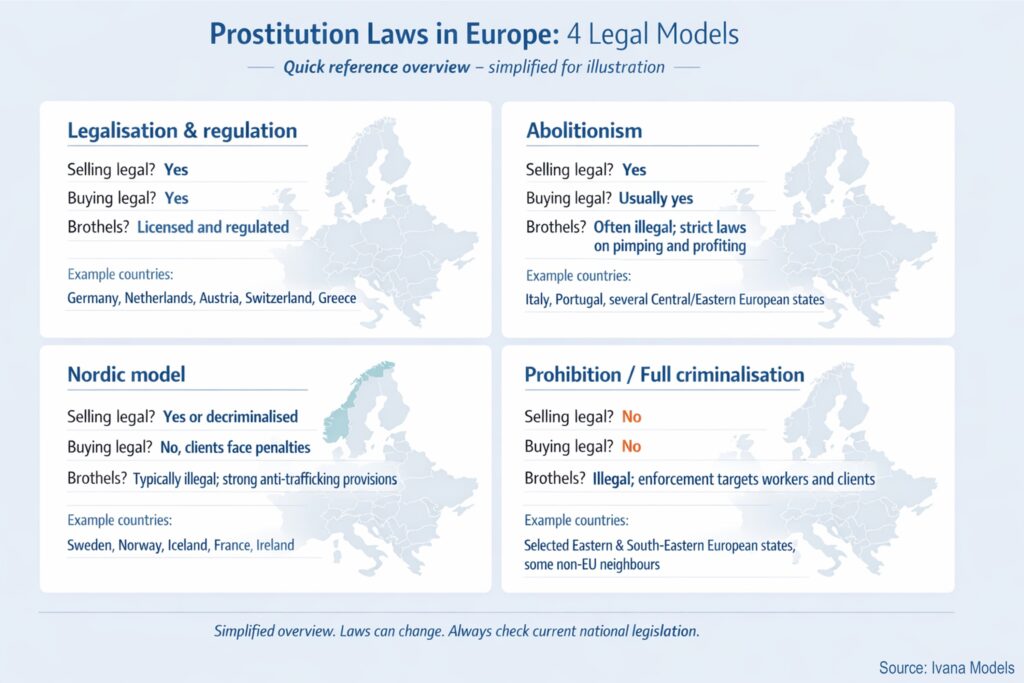
Legalisation & regulation
Selling legal? Yes.
Buying legal? Yes.
Brothels? Licensed and regulated.
Example countries: Germany, Netherlands, Austria, Switzerland, Greece.
Abolitionism
Selling legal? Yes.
Buying legal? Usually yes.
Brothels? Often illegal; strict laws on pimping and profiting from others’ prostitution.
Example countries: Italy, Portugal and several Central/Eastern European states.
Nordic model
Selling legal? Yes or decriminalised.
Buying legal? No, clients face penalties.
Brothels? Typically illegal; strong anti-trafficking provisions.
Example countries: Sweden, Norway, Iceland, France, Ireland.
Prohibition / full criminalisation
Selling legal? No.
Buying legal? No.
Brothels? Illegal; enforcement focuses on both workers and clients.
Example countries: selected Eastern and South-Eastern European states and some non-EU neighbours.


Methodology, Sources & Further Reading
How Data and Studies Were Selected
This article is based primarily on:
- European Parliament – European Parliamentary Research Service (EPRS) studies on prostitution laws and policies in EU member states.
- European mapping projects such as TAMPEP – European Network for HIV/STI Prevention and Health Promotion among Migrant Sex Workers reports on sex work, migration and HIV.
- Academic analyses comparing policy models and constitutional frameworks, for example expertise from the Observatory for Sociopolitical Developments in Europe.
- Country-level overviews of prostitution in Europe, including resources hosted by the Global Network of Sex Work Projects (NSWP) and similar organisations, with particular focus on legal status and enforcement practice.
Where sources disagreed, the article reports ranges or notes the controversy instead of presenting a single definitive claim. The goal is to provide a clear map of the main models, not to declare one approach “proven” superior.
Limitations and Caveats
Readers should bear in mind that:
- laws change over time; check national legislation for the most recent updates,
- data on prostitution and trafficking are often incomplete or influenced by enforcement intensity,
- political actors may highlight or downplay certain figures to support their preferred model,
- local practice (tolerance, crackdowns, informal arrangements) can differ significantly within the same legal model.
Suggested Citation
Ivana Models (2026): “Prostitution Laws in Europe: 4 Legal Models Explained”, Ivana Models Magazine – Research & Statistics, https://ivana-models-escortservice.de/en/blog/prostitution-laws-europe/.
Further Reading
- European Parliamentary Research Service (2024): Regulation of Prostitution in the European Union: Laws and Policies in Selected Member States – European Parliament.
- European Parliament (2021): The differing EU Member States’ regulations on prostitution and their cross-border implications on women’s rights – Directorate-General for Internal Policies.
- TAMPEP (2009): Sex Work in Europe – A Mapping of the Prostitution Scene in 25 European Countries – TAMPEP European Network for HIV/STI Prevention and Health Promotion among Migrant Sex Workers.
- Reinschmidt, L. (2016): Prostitution in Europe between regulation and prohibition – four models – Observatory for Sociopolitical Developments in Europe.
- Background materials on the Nordic model and demand-focused laws, including the European Parliament resolution (2014) on sexual exploitation and prostitution and its impact on gender equality and the Council of Europe Commissioner’s commentary “Protecting the human rights of sex workers”.
As new legislation and research emerge, Ivana Models’ Research & Statistics section will continue to update and expand its coverage of sex work laws and policies in Europe.