
Table of contents
- Table of Contents
- Introduction – Why Germany Matters in the Sex Work Debate
- Key Facts at a Glance (TL;DR)
- Definitions & Scope – What We Mean by “Sex Work”
- Sex work, prostitution and escort services
- Work settings included in this overview
- Limits of this article
- Legal Framework – How Sex Work Is Regulated in Germany
- From the Prostitution Act (2002) to the Prostitute Protection Act (2017)
- Legal status of selling and buying sex
- Registration duties for sex workers
- Licensing of prostitution businesses and local rules
- Grey zones and enforcement challenges
- How Many Sex Workers Are There in Germany?
- Why exact numbers are difficult
- Registered sex workers under ProstSchG
- Estimated total number of sex workers
- Regional concentration and major cities
- Market Size & Economic Role
- Revenue estimates and macroeconomic weight
- Prostitution businesses and associated sectors
- Tourism, business travel and demand
- The place of high-class escorting within the market
- Who Works in the German Sex Industry? (Demographics)
- Age structure
- Gender diversity
- Migrant sex workers and origin regions
- Work Settings – Street, Brothel, Escort, Online
- Street-based sex work
- Brothels, clubs and Laufhäuser
- Escort services and independent escorts
- Online and digital sex work
- Safety, Violence & Working Conditions
- Violence and risk by setting
- Impact of the legal framework on safety
- Mental health, stigma and access to services
- Economic precarity and working conditions
- Public Debate & Reform Proposals
- Calls for the Nordic model or stricter rules
- Sex worker rights perspectives
- Where the discussion stands today
- Key Statistics Summary (Cheat Sheet)
- How to cite this article
- Methodology, Sources & Further Reading
- How data and studies were selected
- Limitations and data gaps
- Further reading
From the outside, sex work in Germany can look like a mystery: legal but controversial, highly visible yet statistically opaque. Is Germany really “Europe’s brothel”? How many people actually work in the industry, how is it regulated, and where do discreet escort services fit into this complex picture? This article takes you behind the headlines and into the numbers, laws and realities that shape sex work in Germany today.

Mit dem Laden des Videos akzeptieren Sie die Datenschutzerklärung von YouTube.
Mehr erfahren
Table of Contents
- Introduction – Why Germany Matters in the Sex Work Debate
- Key Facts at a Glance (TL;DR)
- Definitions & Scope – What We Mean by “Sex Work”
- Legal Framework – How Sex Work Is Regulated in Germany
- How Many Sex Workers Are There in Germany?
- Market Size & Economic Role
- Who Works in the German Sex Industry? (Demographics)
- Work Settings – Street, Brothel, Escort, Online
- Safety, Violence & Working Conditions
- Public Debate & Reform Proposals
- Key Statistics Summary (Cheat Sheet)
- Methodology, Sources & Further Reading
Introduction – Why Germany Matters in the Sex Work Debate
Germany is one of the few countries in the world where selling and buying sexual services are legal under a dedicated framework. Since the early 2000s, it has become a central reference point in international debates about prostitution policy: supporters present the “German model” as an example of regulation and labour rights, while critics see it as a warning about large-scale commercialisation of sex.
At the same time, basic questions remain surprisingly hard to answer. Even the federal government acknowledges that it does not know the exact number of people working in prostitution; estimates range widely, and data quality varies by region and work setting.
This article is written for journalists, researchers, policy makers and informed clients who want a neutral, data-based overview of sex work in Germany. It combines official statistics, academic research and NGO reports to give a structured picture of the legal framework, market size, demographics, working contexts and safety issues.
Ivana Models Escort Service operates in the legal, indoor, high-end segment of this market. That position creates a strong interest in transparent, evidence-based information—far away from sensationalism, but also honest about the gaps and controversies in the data.


Key Facts at a Glance (TL;DR)
- Legal status: Selling and buying sex are legal in Germany. Sex work is regulated primarily by the 2002 Prostitution Act and the 2017 Prostitute Protection Act (ProstSchG).
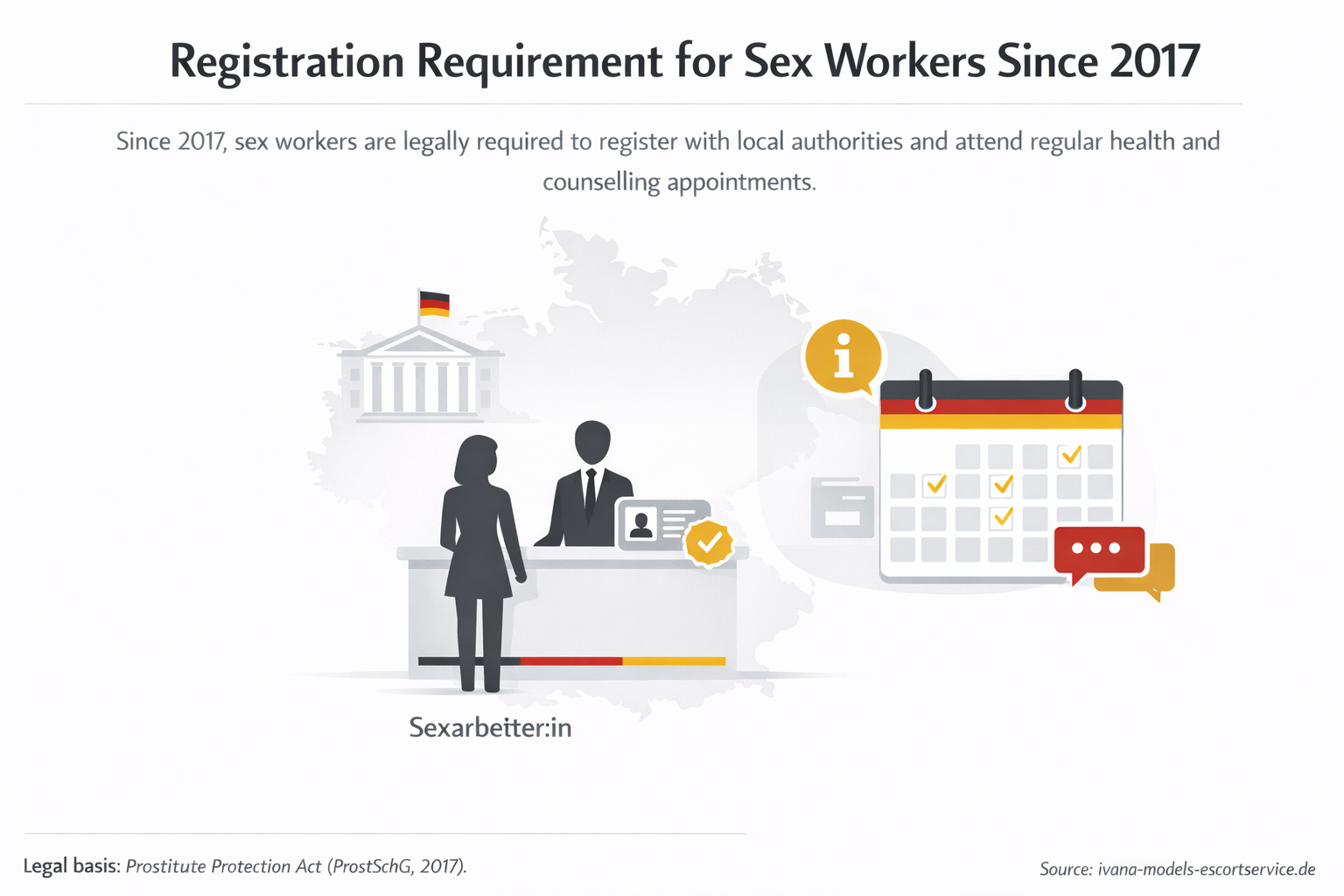
- Registration: Since 2017, sex workers are legally required to register with local authorities and attend regular health and counselling appointments.
- Registered workers: At the end of 2022, around 28,280 people were officially registered as prostitutes. Before the pandemic, the figure was about 40,400 (2019).
- Total estimates: Government and expert estimates for the total number of people in prostitution, including unregistered workers, typically range from around 90,000 to 400,000.
- Market size: Trade unions and economic analyses have estimated the German prostitution market at roughly €14–15 billion annually in the 2010s, equivalent to around 0.4% of GDP at the time.
- Registered businesses: In 2021–2022, around 2,300 prostitution businesses (brothels, clubs, agencies and related companies) held permits under ProstSchG.
- Migrant workers: Many studies suggest that a majority of sex workers in Germany have a migration background, with significant numbers from Central and Eastern Europe.
- Demand: One federal estimate suggests that up to 1.2 million men in Germany purchase sexual services on an average day, though this number is disputed and highlights the uncertainty of demand-side data.
- Risk profile: Research consistently finds that street-based sex work is associated with much higher levels of violence and health risk than indoor work. Escorting and other indoor forms tend to be comparatively safer, especially when workers can screen clients and control the setting.
Each section below digs deeper into these numbers and explains how they were produced, what they can—and cannot—tell us about sex work in Germany.

Definitions & Scope – What We Mean by “Sex Work”
Sex work, prostitution and escort services
“Prostitution” in everyday language often refers to any situation where sexual services are exchanged for money. Within policy and research contexts, the broader term “sex work” is increasingly used to emphasise the labour aspect and to cover a wide set of activities—from street-based work and brothels to discreet escorting, erotic massage, camming and subscription-based online content.
For the purposes of this article, the term sex work includes adults who offer sexual or erotic services for payment on a regular or occasional basis, regardless of gender or migration status. The word prostitution is used only when referring to legal texts or official statistics that employ that term.
Escort services are treated as a specific segment within sex work. They typically involve pre-booked appointments, often in hotels or private apartments, with a strong focus on social interaction, companionship and discretion. In the high-end segment, bookings may include travel, events and extended GFE-style dates, and are typically arranged through agencies or independent online profiles.
Work settings included in this overview
When researchers describe the German sex industry, they often distinguish between several overlapping settings:
- Street-based sex work: visible, often low-priced services in designated zones or tolerated areas.
- Indoor venues: brothels, clubs, “Laufhäuser” (walk-in brothels), massage studios, private apartments and similar premises.
- Escort services: agency-based or independent escorting centred on off-site meetings—usually in hotels, private accommodations or on trips.
- Online/digital sex work: webcam shows, subscription platforms such as OnlyFans, and other remote or digital forms of erotic content creation.
These categories regularly overlap. For example, a person may work in a club some nights, offer escort services on others, and maintain an OnlyFans account at the same time.
Limits of this article
This overview focuses on adult, consensual sex work in Germany. Trafficking, coercion and exploitation are crucial issues but are not identical to sex work as such. Data on trafficking cases and forced prostitution exist, but they use different legal definitions and require a separate, in-depth discussion.
Where studies give separate numbers on minors, trafficking victims or people in coercive situations, this article notes that, but it does not attempt to quantify exploitation within the overall market in simple percentages—partly because such numbers are often used in highly politicised ways and are contested among researchers.

Legal Framework – How Sex Work Is Regulated in Germany
From the Prostitution Act (2002) to the Prostitute Protection Act (2017)
For much of the 20th century, prostitution in Germany was tolerated but considered “immoral” under civil law. Contracts were unenforceable, and sex workers lacked access to normal labour protections. This changed with the Prostitution Act (Prostitutionsgesetz, ProstG), which came into force in 2002. The law recognised prostitution as a legitimate service, allowed sex workers to sue for payment, and aimed to improve access to social insurance and labour rights.
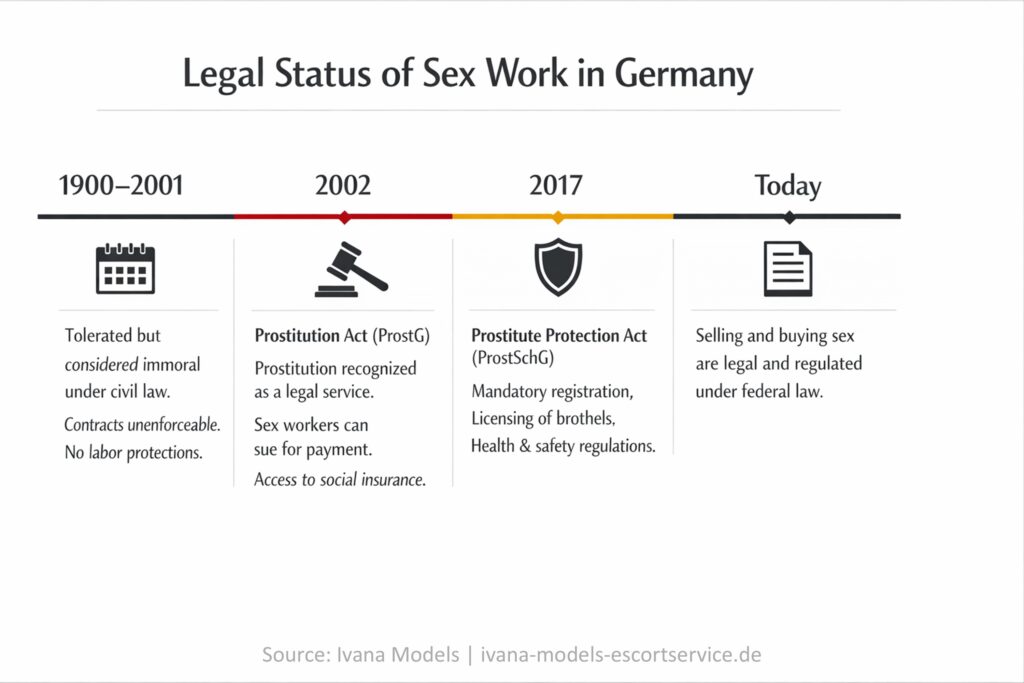
However, the 2002 reform left many aspects unregulated. In particular, there was no national registration system or uniform licensing rules for brothels. Critics argued that the sector had expanded without adequate oversight or protection.
In response, the federal government introduced the Prostitute Protection Act (Prostituiertenschutzgesetz, ProstSchG), which came into force on 1 July 2017. This law remains the central regulatory framework today.

Legal status of selling and buying sex
Under German federal law:
- Adults may legally sell sexual services on a self-employed basis or as employees in licensed establishments.
- Clients may legally purchase sexual services, as long as all parties are adults and consent freely.
- Operating prostitution businesses (brothels, clubs, escort agencies, certain massage studios) is legal, provided the operator has a permit and complies with local regulations.
Criminal law still applies to coercion, trafficking, exploitation, violence, pimping in exploitative forms and the involvement of minors. The legalisation of sex work did not decriminalise these offences; it introduced a regulated framework for consensual adult sex work while keeping exploitation and trafficking criminal.
Registration duties for sex workers
The ProstSchG introduced a mandatory registration requirement for anyone providing sexual services in Germany. Sex workers must:
- Register personally with the competent authority in the city or district where they work.
- Attend a confidential counselling and health information session.
- Renew their registration periodically (every two or three years, depending on age).
- Carry a registration certificate (a card) when working and show it during inspections.
According to the law’s official justification, these duties aim to ensure that sex workers receive information on their rights, health services and support options, and to give authorities a better overview of the sector.
Licensing of prostitution businesses and local rules
Prostitution businesses—including brothels, clubs, escort agencies and certain forms of event or rental businesses—must obtain a permit under ProstSchG. Operators must prove personal reliability, submit concepts for health and safety, and comply with local planning and zoning rules.
Municipalities may define restricted zones (Sperrbezirke) where street prostitution is banned or limited, and may impose additional regulations, for example on opening hours or advertising. This leads to a patchwork of local rules, especially for street-based work and visible venues in city centres.
Grey zones and enforcement challenges
Despite the formal framework, large parts of the market remain only partially regulated. Some workers choose not to register, either because they fear stigma, worry about data protection, or find the bureaucracy and fees burdensome. Evaluation reports suggest that perhaps only 40–50% of the estimated sex worker population is registered, although the exact percentage is uncertain.
Unregistered work may take place in private apartments, informal venues or online, making enforcement difficult. As a result, official statistics must always be interpreted as partial snapshots rather than complete maps of the sector.

How Many Sex Workers Are There in Germany?
Why exact numbers are difficult
Counting sex workers is more complicated than counting employees in most other professions. Many people move in and out of the sector, work part time, or combine different roles. Others avoid official registration out of fear of stigma, immigration issues, tax concerns or distrust of authorities. Indoor and online work is often invisible to casual observers, while visible street-based work is only a small portion of the total market.
Different studies use different definitions—some count only full-time street-based workers; others include part-time, online and occasional work. That is why German and international estimates vary so widely.
Registered sex workers under ProstSchG
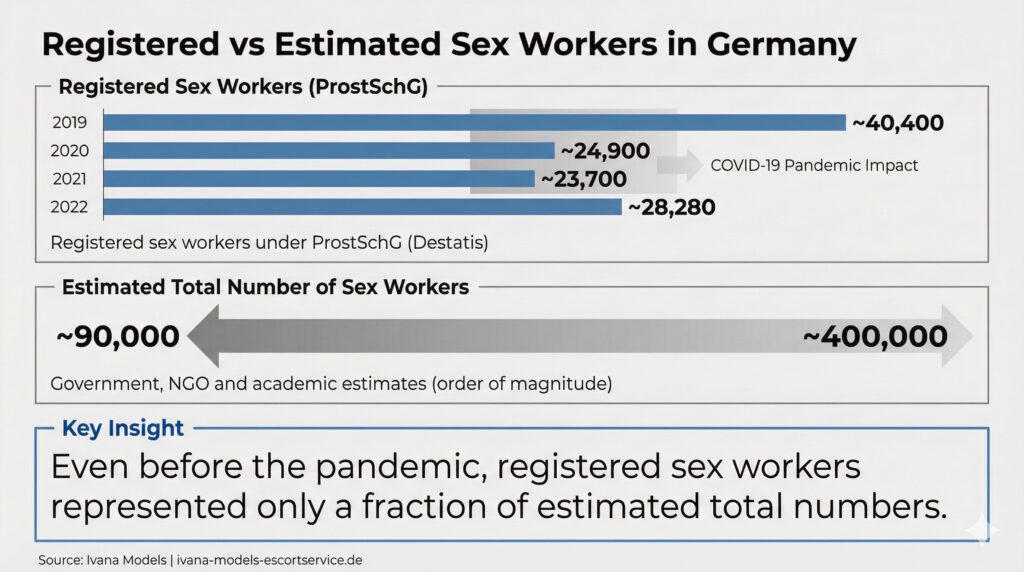
The most solid figures describe registered sex workers under ProstSchG. According to the Federal Statistical Office (Destatis):
- At the end of 2019, roughly 40,400 people held a valid registration.
- At the end of 2020, during the COVID-19 pandemic and widespread business closures, this figure dropped to about 24,900.
- At the end of 2021, there were around 23,700 registered sex workers.
- By the end of 2022, the number had risen again to about 28,280, as pandemic restrictions were gradually lifted.
These numbers show clear pandemic effects but also illustrate a deeper issue: even before COVID-19, registration figures were far below most estimates of the total number of sex workers in Germany.
Estimated total number of sex workers
Various government statements, NGO reports and academic analyses attempt to estimate the total number of people working in prostitution, including those who are not registered. Because methods differ, the results span a very broad range.
For example:
- In earlier economic and social studies, national estimates often ranged between roughly 60,000 and 200,000 sex workers.
- Some NGOs and trade union sources, as well as several widely cited analyses in the 2000s, have suggested figures of around 400,000 people working full- or part-time in prostitution.
- A recent statement about the evaluation of ProstSchG notes that federal estimates still range roughly from 90,000 to 400,000, and that the government itself explicitly recognises the uncertainty.
These ranges should therefore be read as orders of magnitude, not precise counts. What they do suggest is that the German sex industry is substantial in size, and that registered workers probably represent only a fraction of the total population.
Regional concentration and major cities
Available studies and local reports indicate that sex work is heavily concentrated in larger urban areas and along major transport routes. Cities such as Berlin, Hamburg, Cologne, Frankfurt, Munich, Stuttgart and Düsseldorf have well-known red-light districts and clusters of indoor venues, as well as significant escort and apartment-based markets.
Smaller towns may have only a few apartments, massage studios or a small number of street-based workers. Some rural regions report almost no visible sex work but may still host discreet escort appointments or online-based work that leaves few traces in local records.


Market Size & Economic Role
Revenue estimates and macroeconomic weight
Estimating the total revenue of the German prostitution market faces similar challenges as counting sex workers. Nevertheless, several economic analyses and trade union estimates give a rough idea of the scale:
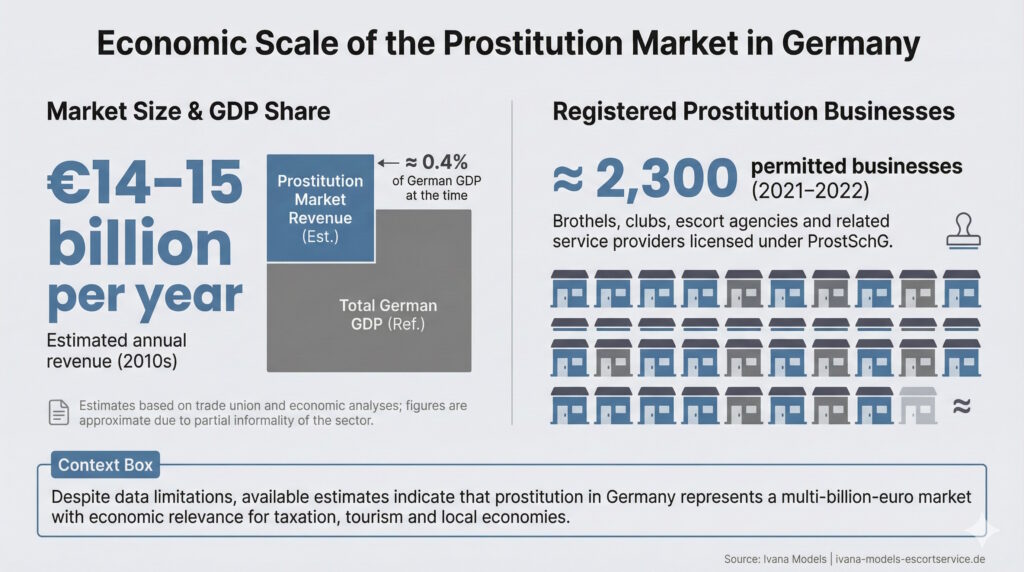
- In the early 2010s, the public services trade union Ver.di and other sources estimated the market at around €14.5 billion per year.
- Some economic articles referencing Destatis estimates have suggested similar magnitudes, interpreting this as about 0.4% of German GDP at the time.
Given that the sector is partly underground and often cash-based, these figures should be read as approximate. But they underline that sex work is not a marginal side business: it represents a multi-billion-euro market with implications for tax revenue, tourism and local economies.
Prostitution businesses and associated sectors
Official statistics on registered prostitution businesses provide another window into the economic landscape. Destatis data show that around 2,290 to 2,310 prostitution businesses—brothels, clubs, escort agencies and related service providers—held permits in 2021–2022.
These businesses vary enormously in size and profile, from small apartments with a few workers to large multi-floor clubs, as well as agencies that operate mainly online and on the phone. Their activity also supports secondary sectors such as hospitality, transport, security, cleaning, advertising and real estate.

Tourism, business travel and demand
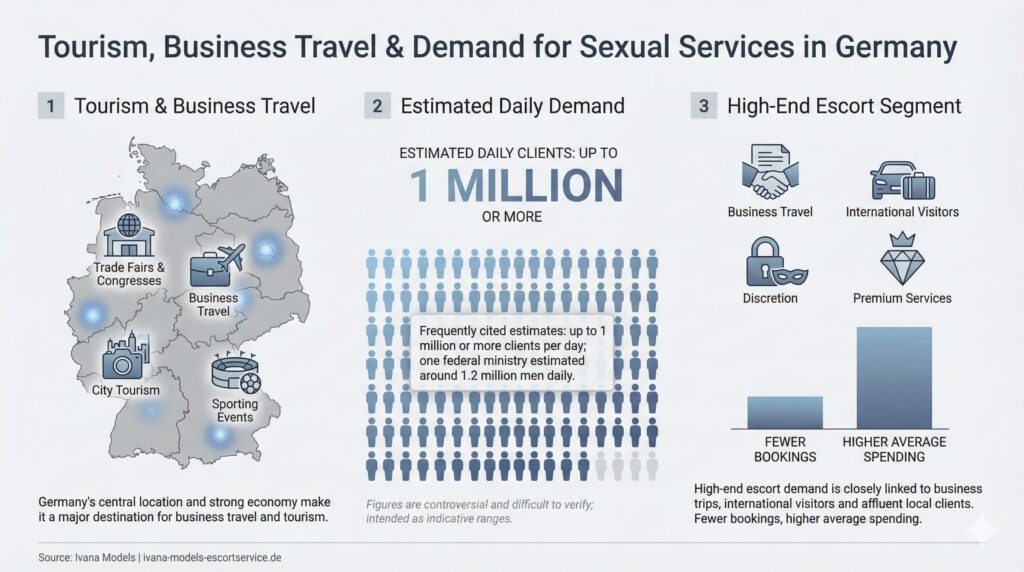
Germany’s central location and strong economy make it a major destination for business travel and tourism. Trade fairs, congresses, sporting events and city tourism generate additional demand for companionship and sexual services, particularly in large cities and border regions.
News reports and parliamentary discussions frequently cite estimates that up to one million or more clients per day purchase sexual services in Germany; one federal ministry estimated around 1.2 million men daily. These numbers are controversial and hard to verify, but even if the real figure were substantially lower, they still imply a large and steady demand.
For high-end escort services, demand is closely linked to business trips, international visitors and affluent local clients who value discretion and quality over price. In this segment, the number of bookings is far smaller than in the low-cost sector, but average spending per booking is much higher.
The place of high-class escorting within the market
Within the overall sex industry, high-class escorting and premium companionship form a relatively small but economically significant niche. Bookings are usually longer—an evening, a night, a weekend or a trip—and include not just intimacy but also social presence at dinners, events, trade fairs or private celebrations.
Compared to street-based or low-cost indoor work, this segment tends to involve:
- Higher income per appointment and fewer daily bookings.
- More selective clientele, often professionals, entrepreneurs and international visitors.
- A strong emphasis on screening, communication, discretion and personal compatibility.
Because many escorts operate independently or via small agencies, and often keep a low profile, this part of the market is difficult to quantify statistically. Nonetheless, it plays an outsized role in public debates and media portrayals of sex work—precisely because it intersects with luxury lifestyles, travel and social status.

Who Works in the German Sex Industry? (Demographics)
Age structure
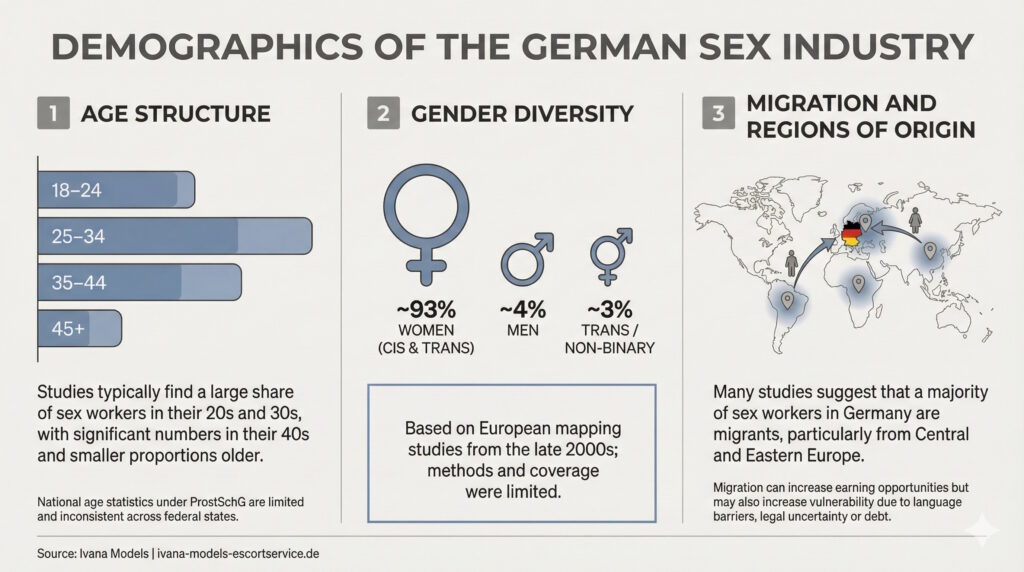
Most available studies focus on adult women in indoor and street-based settings. They typically find that a large share of sex workers are in their 20s and 30s, with significant numbers in their 40s and a smaller proportion older than that. Entry ages vary: some start shortly after turning 18, others enter in their mid-20s or later, often after other forms of precarious or low-paid work.
Reliable national statistics on age distribution under ProstSchG are limited, partly because not all federal states collect or report age data in the same way. Local projects, however, often note a mixture of young newcomers and more experienced workers who have been in the industry for many years.
Gender diversity
Sex work in Germany is frequently associated with women, and women do form the majority of workers in most studies. However, there are also male sex workers and trans and non-binary sex workers, including in escorting, street work and online platforms.
A European mapping project in the late 2000s, for example, reported that roughly 93% of sex workers in Germany were women, around 4% men and 3% transgender, though methods and coverage were limited. More recent research highlights that male and trans sex workers face specific risks and health issues, including higher HIV prevalence in some subgroups.
Migrant sex workers and origin regions
One of the most striking features of the German sex industry is the importance of migration. Many studies suggest that a majority of sex workers in Germany are migrants, particularly from Central and Eastern Europe (for example Romania, Bulgaria, Hungary, Poland and the Czech Republic), but also from Latin America, Africa and parts of Asia.
Several factors contribute to this pattern:
- Economic inequality and limited job opportunities in countries of origin.
- Freedom of movement within the European Union, making it easier to travel for work.
- Existing networks of friends, relatives or intermediaries who help organise travel and accommodation.
Migration can increase earning opportunities but may also increase vulnerability, especially when language barriers, unclear legal status or debt to intermediaries are involved. This complexity is one reason why debates around trafficking, coercion and agency in German prostitution are so heated.

Work Settings – Street, Brothel, Escort, Online
Street-based sex work
Street-based sex work is the most visible but numerically smallest segment in many German cities. Workers typically offer short, low-priced encounters in designated zones or tolerated areas. Municipalities can restrict street prostitution through local ordinances, creating “Sperrbezirke” where solicitation is forbidden.
Street work is often associated with higher levels of poverty, unstable housing, substance use and contact with police. At the same time, some cities have introduced measures such as “sex drive-in” facilities or supervised zones with alarm buttons, outreach services and basic facilities to reduce risks.


Brothels, clubs and Laufhäuser
Germany is well-known for its variety of indoor venues:
- Classic brothels with rooms rented to workers on a daily or weekly basis.
- Sauna clubs and FKK-clubs, which combine wellness-style facilities with sexual services.
- Laufhäuser, where clients walk past open or semi-open doors and negotiate directly with workers.
- Studios and massage salons, which may offer a mix of erotic massage and sexual services.
These businesses must obtain permits under ProstSchG and comply with zoning and safety rules. Destatis statistics on registered prostitution businesses include many such venues, as well as some escort agencies and related service providers.
Working conditions vary widely between venues—from relatively structured, professional environments to places with high pressure, debt bondage or control by third parties. This diversity is one reason why broad generalisations about “brothels” can be misleading.
Escort services and independent escorts
Escort work typically takes place away from red-light districts and dedicated venues. Appointments are booked in advance and take place in hotels, restaurants, private apartments or at events. Many escorts present themselves online with professional photos, detailed profiles and clearly defined boundaries and services.
Escort services in Germany can be organised as:
- Agencies: which handle marketing, client communication and sometimes logistics.
- Independent escorts: who manage their own websites, social media and bookings.
- Hybrid models: where escorts collaborate with one or several agencies while also maintaining independent channels.
Because the activity is dispersed and often discreet, escorting is rarely captured in specific statistics. In many datasets, it is grouped under “indoor prostitution” or “other locations”. Yet in terms of income per booking and social visibility, the escort segment is significant.
High-end agencies like Ivana Models place particular emphasis on screening, communication quality, compatibility and discretion. Within the overall risk spectrum of sex work, this combination of indoor settings, advance vetting and relatively empowered workers tends to be associated with lower levels of physical violence compared to street-based work.

Online and digital sex work
The last decade has seen rapid growth in online and digital sex work, including:
- Webcam shows on specialised platforms.
- Subscription-based content on services such as OnlyFans and similar sites.
- Custom content sold through messaging apps or individual websites.
Some German-based sex workers now earn most or all of their income online. Others use digital channels as a supplement or for advertising offline services. Research suggests that digital work can reduce certain physical risks, but it also brings new challenges: platform dependency, online harassment, non-consensual sharing of content and blurred jurisdiction across borders.
At present, there is no unified dataset for digital sex work in Germany. Most insights come from platform statistics, qualitative research and broader studies on gig-work and digital labour.

Safety, Violence & Working Conditions
Violence and risk by setting
International research consistently shows that the risk of violence varies greatly between different forms of sex work. Global systematic reviews find that street-based workers experience the highest rates of physical and sexual violence, while indoor workers and escorts generally report lower—but still significant—levels of harm.
In Germany, qualitative studies and project reports mirror this pattern. Street-based workers and those in precarious or unlicensed indoor arrangements often report violence from clients, partners, third parties and, sometimes, police or security personnel. Indoor workers with more control over clients and settings, including many escorts, describe lower levels of overt violence but may still face harassment, economic pressure and online abuse.
Impact of the legal framework on safety
One of the key promises of the 2002 and 2017 laws was improved safety and health protection. The effects are mixed:
- Pros: Legal recognition and registration can make it easier to contact health services, report crimes and access information about rights. Some sex workers report feeling more legitimised and less vulnerable in interactions with police or landlords.
- Cons: Mandatory registration, bureaucratic requirements and local zoning can push some workers into unregistered or less visible sectors, especially migrants and independents. These workers may be less likely to seek help, making them more vulnerable despite the formal protections on paper.
Evaluations of ProstSchG emphasise that legislation alone does not guarantee safety; implementation, resources for counselling centres, and relationships between authorities and sex worker communities are crucial.

Mental health, stigma and access to services
Recent studies from Germany highlight the close connection between violence, stigma and mental health. Sex workers who experience repeated violence, discrimination or social isolation show higher rates of depression, anxiety and trauma-related symptoms.
At the same time, stigma and fear of judgement can deter people from seeking medical or psychological help. Some workers report negative experiences with health professionals or social services who treat them as victims or criminals rather than as clients. This is particularly pronounced for migrants, trans workers and people who use drugs.
Projects that combine low-threshold health services with non-judgmental counselling, peer support and legal advice tend to report better outcomes, but coverage varies by region and funding priorities.
Economic precarity and working conditions
While high-end escorting can offer good income and flexible working conditions for some, many sex workers—especially in lower-priced sectors—face economic insecurity. They may have to pay high room fees, agency commissions or debts to intermediaries. During the COVID-19 lockdowns, many lost their income overnight and were not eligible for regular forms of wage support, highlighting how fragile economic security can be in this industry.
Access to social insurance, pensions and unemployment benefits remains uneven. Some self-employed sex workers pay into regular schemes; others rely on informal arrangements or have gaps in their contribution records, which can lead to poverty in old age.


Public Debate & Reform Proposals
Calls for the Nordic model or stricter rules
Germany’s legalisation model has attracted sustained criticism, both domestically and internationally. Abolitionist groups and some feminist organisations argue that legalisation has expanded the market, benefited brothel owners and pimps, and failed to protect those in the most precarious situations. They cite high numbers of trafficking investigations and dramatic estimates of exploitation to argue that Germany should move towards a “Nordic model” that criminalises the purchase of sex while decriminalising the selling.
Several political parties have proposed reforms in this direction, including stricter rules on advertising, higher penalties for clients who buy sex from trafficked persons, and in some cases a complete reversal of the 2002 legalisation.
Sex worker rights perspectives
Sex worker-led organisations and many social work projects take a different view. They argue that criminalising clients would push the market further underground, making screening harder and increasing risks. Instead, they call for:
- Reducing bureaucratic barriers and making registration voluntary rather than mandatory.
- Strengthening labour rights and access to social insurance.
- Improving funding for health and counselling services independent of law enforcement.
- Addressing exploitation through targeted action against coercive actors, not against consensual adult sex work.
From this perspective, the main problem is not the existence of legal sex work itself, but the combination of social stigma, economic inequality and inconsistent enforcement.

Where the discussion stands today
As of the mid-2020s, Germany has not fundamentally changed its legal model, but debates continue. Parliamentary commissions have reviewed the impacts of ProstSchG, and advocacy groups on all sides use the limited data to support very different narratives.
For observers and decision-makers, the key challenge is to separate evidence-based findings from ideological claims, and to recognise both the benefits and the limitations of the current framework. This requires better data, transparent evaluations and serious engagement with the voices of sex workers themselves—across different sectors, including street work, brothels, escorting and digital platforms.

Key Statistics Summary (Cheat Sheet)
For quick reference, here is a condensed list of core figures discussed in this article. All numbers are approximate and subject to the limitations explained above.
- Legal model: Sex work is legal and regulated; coercion, trafficking and the involvement of minors remain criminal offences.
- Registered sex workers: 40,400 (2019); 24,900 (2020); 23,700 (2021); 28,280 (2022).
- Estimated total number of sex workers: commonly cited ranges from roughly 90,000 to 400,000 people.
- Registered prostitution businesses: around 2,300 venues and operators with permits in 2021–2022.
- Estimated market volume: roughly €14–15 billion annually in the 2010s, or about 0.4% of German GDP at the time.
- Migration: many studies suggest that a majority of sex workers in Germany are migrants, especially from Central and Eastern Europe.
- Gender distribution: older European data indicated around 90%+ women, with smaller shares of male and transgender workers; exact current shares are unknown.
- Demand: one contested federal estimate suggests up to 1.2 million men purchasing sexual services on an average day.
- Risk by setting: violence and health risks are highest in street-based work and lower in indoor settings where workers have more control, such as regulated brothels and vetted escort arrangements.
How to cite this article
If you wish to reference this overview, you may use a citation such as:
Ivana Models (2026): “Sex Work in Germany: Law, Market Size & Key Statistics”, Ivana Models Magazine – Research & Statistics, https://ivana-models-escortservice.de/en/blog/prostitution-germany-law-numbers-reality/.

Methodology, Sources & Further Reading
How data and studies were selected
This article draws on a wide range of sources, including:
- Official statistics from the German Federal Statistical Office (Destatis) on registered sex workers and prostitution businesses.
- Legal texts and explanatory materials on the Prostitution Act (2002) and the Prostitute Protection Act (2017).
- Academic studies and economic analyses on the size of the sex industry, migration patterns and the impacts of legalisation, such as “Prostitution in Germany – A Comprehensive Analysis of Complex Challenges”.
- European Parliament and other European and international reports on sex work, trafficking, HIV and violence.
- Media reports summarising Destatis data and parliamentary debates.
Where sources disagree, this article notes the range of estimates rather than choosing a single “true” number. The goal is to provide context and transparency, not to settle ideological disputes.
Limitations and data gaps
The main limitations of the available data include:
- Underreporting: many sex workers are not registered, especially in informal and digital sectors.
- Different definitions: studies may count different activities or time periods, making direct comparison difficult.
- Selection bias: surveys often reach only certain groups—those connected to support projects, particular venues or online platforms.
- Political framing: some statistics are produced or highlighted by actors with strong abolitionist or pro-decriminalisation agendas.
Readers should therefore treat all numbers as approximations and pay close attention to the underlying methods when using them in their own work.
Further reading
- Federal Statistical Office (Destatis) – annual press releases and data tables on registered prostitutes and prostitution businesses.
- Text and explanatory materials on the Prostitute Protection Act (ProstSchG) published by the Federal Ministry for Family Affairs, Senior Citizens, Women and Youth (BMFSFJ).
- “Prostitution in Germany – A Comprehensive Analysis of Complex Challenges” – detailed study on the German sex market and policy debates.
- European Parliament reports on sexual exploitation, prostitution and legal frameworks in EU member states.
- Recent research on sex worker health, mental health and violence in Germany and Europe.
This overview is intended as a starting point. As new data, evaluations and research projects appear, Ivana Models’ Research & Statistics section will continue to update and expand its coverage of sex work and escort services in Germany.